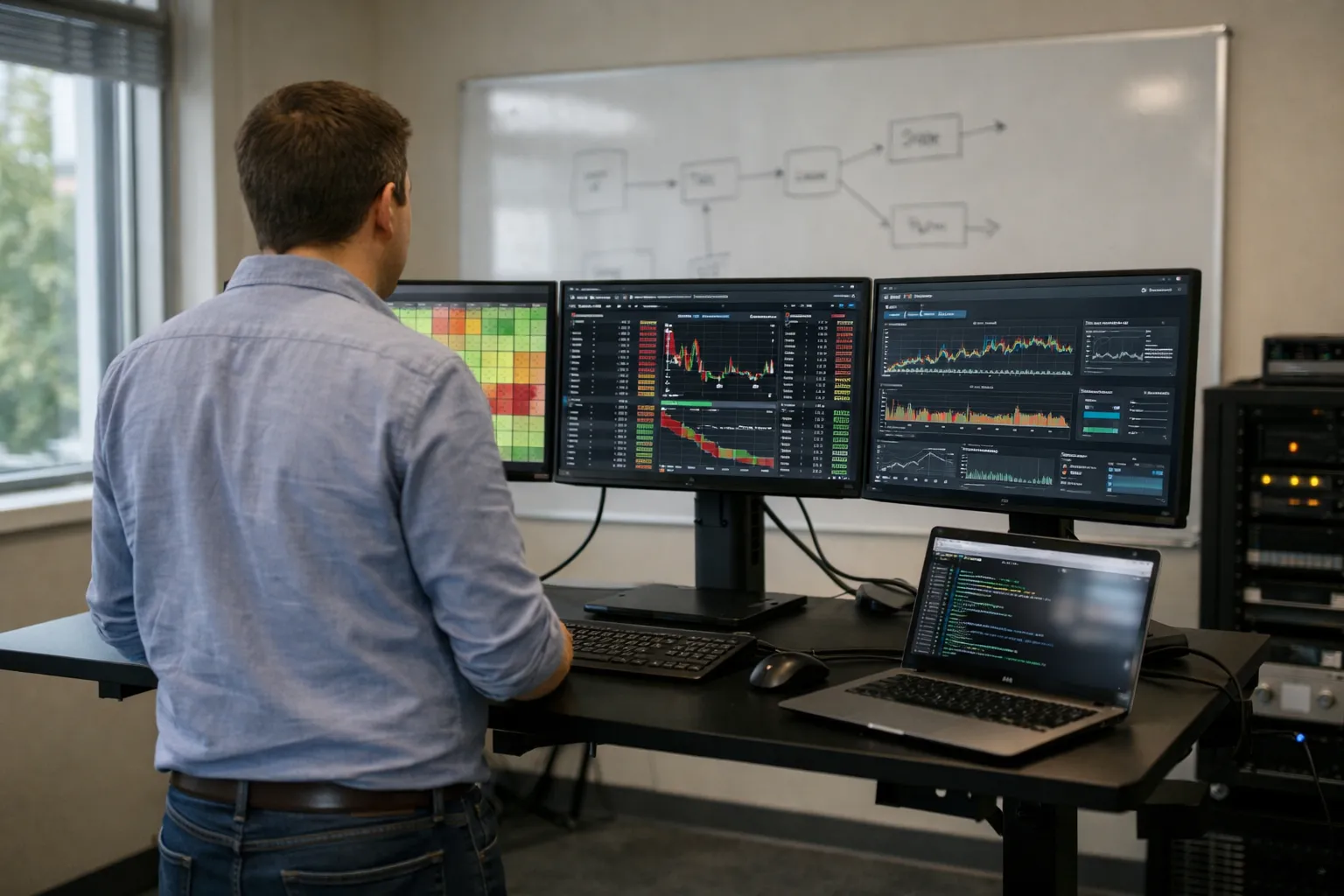
What you'll learn: how to build, backtest and operate a funding‑rate arbitrage bot that captures periodic perp funding while remaining delta‑neutral across centralized exchanges (CEXs) and on‑chain perpetuals (DEX perps). This updated August 2026 guide is for active crypto traders and engineers who want actionable rules, recent market context, and operational best practices that reflect changes through H1–H2 2026.
Why funding‑rate arbitrage still matters in Aug 2026
Funding‑rate arbitrage remains a core hedged income strategy because perpetual markets continue to be fragmented across venue types, regionally varied funding regimes, and on‑chain vs off‑chain indexing. In 2026 those structural features persist and in some cases intensified:
- L2/perp growth: A larger share of perp volume has migrated to rollups and dedicated perp L2s, improving on‑chain liquidity but increasing index and funding heterogeneity across venues.
- Dynamic funding models: Several DEX perps and newer CEX products introduced dynamic funding and fee‑rebate mechanics, changing payout timing and predictability.
- Operational arms race: Better APIs, exchange metadata (predicted funding, funding caps), and mature indexers make automation more practical — but they also compress easy edges as more participants deploy similar strategies.
Why it matters: your edge is now operational superiority — faster, more accurate funding forecasts, conservative sizing, and robust cross‑venue execution — not just a simple premium capture thesis.
Prerequisites and updated toolset
Before you start, ensure these practical preconditions are met:
- Accounts & region strategy: Verified accounts on major CEXs (Binance, Bybit, OKX, Bitget) and wallets/config for L2 perps (dYdX, Perpetual Protocol v3, GMX). Post‑2024 regulatory shifts mean U.S. retail access to CEX perps is more limited — plan jurisdictionally.
- APIs & metadata: Use exchange REST/WebSocket keys and gather funding metadata endpoints. In 2026 several exchanges now publish predicted funding and funding caps via their public APIs — use these where available for better forecasts.
- Infrastructure: Low‑latency cloud instances (multi‑region), containerized services (Docker/Kubernetes), and a monitoring stack (Prometheus + Grafana or Datadog). Host critical services close to exchange endpoints.
- Languages & libs: Python async stacks (asyncio + websockets) remain common; Node.js is viable for evented systems. Continue to prefer custom connectors over raw CCXT for latency‑sensitive execution.
- Data providers: Native exchange websocket feeds for real‑time, and paid historical feeds for backtests. On‑chain perps benefit from archival indexers or RPC services with historical state (The Graph, specialized indexers). Persist raw feeds for replay.
Step 1 — Data pipeline: what to collect and why
Collect three synchronized streams; in 2026 the emphasis is on metadata completeness and provenance:
- Market prices: spot trade price, spot index components, perp mark/index price, and order‑book top N (N≥5). For DEX perps, capture AMM reserves/virtual price snapshots.
- Funding metadata: current funding rate, predicted funding (if published), funding timestamps, funding frequency, caps/limits, and the venue’s funding formula. Save the exchange’s published formula snapshot for auditability.
- Execution state: open positions, entry prices, collateral balances, margin ratios, and outstanding orders per venue. For on‑chain perps include nonce and transaction receipts to reconcile fills.
Design points:
- Use websockets for low latency; persist periodic REST snapshots for reconciliation.
- Normalize symbol conventions and timestamps (UTC ms). Maintain a per‑venue symbol map and index composition map for each spot/index feed.
- Persist raw messages to durable storage (S3/object storage) for reproducible backtests and post‑incident forensics.
Step 2 — Signal: measuring the arbitrage in 2026
Core math remains unchanged but the inputs are richer now:
- Perp premium (%) = (perp_mark - spot_index) / spot_index.
- Expected funding payout = funding_formula(perp_mark, index, interest_component, etc.) × notional over the funding interval — use the venue’s published calculation when available.
Practical rules updated for 2026:
- Only trade when net expected funding − explicit fees − estimated slippage > threshold (example starting threshold: 0.02% per interval). Calibrate threshold by venue and time of day.
- Prefer venues that publish predicted funding; when not available compute it from mark‑index spread plus documented interest terms and compare to historical realized funding variance.
- Enforce liquidity filters: require order‑book depth or AMM virtual liquidity sufficient to cap slippage to a predefined budget (e.g., slippage ≤ 0.03% of notional on both sides).
- Avoid ephemeral signals around index rebalancings and known smart contract upgrade windows; index construction differences can cause apparent premiums that reverse on reindex events.
Step 3 — Execution model and new 2026 tactics
- Buy spot (or accumulate via TWAP or limit ladders) on the venue where you hold spot collateral.
- Open an equal USD‑value short on the perp venue, matching the contract's underlying index exposure.
Updated execution tips:
- Match index construction and settlement currencies. In 2026 some venues shifted to multi‑source index baskets — ensure you're comparing like‑for‑like.
- Use limit orders for the spot leg to control slippage; for the perp leg choose between limit or market depending on the proximity to the funding timestamp and liquidity. When the funding window is imminent, prefer aggressive fills to lock exposure.
- Pre‑fund balances across venues. Cross‑chain bridging remains a drag; liquidity management and pre‑positioning are essential to avoid on‑chain settlement delays.
- Leverage controls: keep perp leverage low (1–3x typical). 2026 saw more automatic cross‑margin and portfolio margin features — use them cautiously and understand cross‑venue contagion risk.
- Keep an automated hedging loop: if one leg partially fills, immediately reduce the other to preserve delta neutrality; implement cancelling and re‑pricing logic with strict timeouts.
Step 4 — Sizing and capital allocation
Principles to apply now:
- Cap exposure per venue (2–5% of capital per venue is a sensible starting point) to limit counterparty or smart contract loss.
- Size trades by the minimum of spot liquidity, perp liquidity, and collateral headroom. On AMM perps, use slippage curves to compute marginal cost of additional notional.
- Model compounding and funding frequency when annualizing expected returns; use realized per‑interval payments in backtests rather than theoretical continuous rates.
Step 5 — Backtesting correctly (and now)
Accurate backtesting is the main differentiator. Updated checklist:
- Ingest historical mark/index prices, funding rates, and timestamped order‑book or AMM snapshots. For on‑chain perps include historical reserve states and index computations.
- Simulate execution with realistic fill models — use historical order‑book depth or AMM slippage curves. For DEX perps include gas & L2 sequencer latency costs.
- Apply funding payments exactly at each venue’s funding timestamps and account for compounded positions across intervals.
- Charge all fees: taker/maker, funding fees, withdrawal/bridge costs, and gas. In 2026 many DEXs introduced gas rebates and LP fee changes — embed fee schedules by date in the backtest data.
- Stress test: run Monte Carlo around funding reversals, index reconstitution events, and adverse correlation moves between spot and perp indices.
Report: net annualized return, per‑venue Sharpe, max drawdown, funding variance and expected time to margin breach. Keep versioned backtest artifacts for auditability.
Step 6 — Risk controls and edge cases (updated)
- Funding reversals: Funding signs can flip rapidly. Implement hard unwind thresholds when predicted funding −threshold or realized funding variance exceeds historical bounds.
- Counterparty & smart contract risk: Diversify across CEXs and vetted DEX perps. Set per‑venue collateral caps and prefer venues with multi‑source indices and audited contracts.
- Liquidation & cross‑margin contagion: Monitor cross‑margin pools and portfolio margin exposures. If your CEX supports cross‑margin, ensure you understand margin calls can affect other positions.
- Oracle & index manipulation: Use venues with robust index construction or add external monitoring to detect suspicious index moves (large trade impact vs. aggregated spot basket divergence).
- Operational circuit breakers: Pause strategies on API checksum failure, repeated order rejections, failed confirmations, or prolonged on‑chain finality delays. Fail‑safe: a kill switch that unwinds into the least risk state (usually spot only).
Step 7 — Monitoring, alerts and live ops
Operational observability is non‑negotiable:
- Dashboards: real‑time P&L per venue, funding heatmap, margin ratios, open orders, and end‑to‑end latency metrics.
- Alerts: funding sign flips, margin threshold crossings, failed fills, or rapid basis moves. Include voice/SMS escalation for critical alarms.
- Runbooks: clear operator playbooks for emergency unwinds, moving collateral, or pausing the bot. Rehearse them quarterly.
Updated example trade walkthrough (illustrative)
Hypothetical example to show cash flows; do not treat as forecast.
- Spot index BTC = $60,000 (hypothetical). Perp mark on Venue A = $60,300 (premium 0.5%). Funding happens every 8 hours and Venue A’s published predicted funding roughly equals mark‑index spread adjusted for interest.
- If fees+slippage are estimated 0.10% per interval, net expected funding ~0.40% per 8h on the notional. Deploy $50k notional on the pair (buy $25k spot, short $25k perp) to keep capital diversified across multiple concurrent trades.
- Expected gross payments over short horizons can look large when annualized; realistic realized yield will be much lower due to downtime, funding volatility, and adverse selection. Backtest and paper trade first.
Deployment checklist
- Comprehensive backtest with historical funding and slippage curves.
- Paper trading for multiple weeks covering different market regimes and funding cycles.
- Small live rollout with strict position and per‑venue caps.
- Gradual scaling only after operational metrics (fill rate, latency, funding realized) are stable.
- Quarterly re‑calibration: funding regimes, index constructions and liquidity profiles change rapidly — revalidate thresholds and backtests quarterly.
Legal, tax and compliance considerations
Regulatory regimes continued to evolve through 2026. Practical steps:
- Track jurisdictional rules — some countries further limited retail access to leveraged CEX perps in 2025–26; structure operations with counsel for cross‑border exposures.
- Record all funding receipts and trades with timestamps for tax reporting. Funding is often treated as income/transfers rather than capital gains in many tax regimes—get local advice.
- Maintain KYC/AML compliance on CEX accounts and consider entity structuring for institutional capital deployment.
Final thoughts
Funding‑rate arbitrage remains viable in Aug 2026 but with a smaller margin for error. The current edge favors teams that combine: accurate funding prediction using venue metadata, conservative sizing, rigorous backtests that include execution realism, and operational reliability. Start small, instrument everything, and prioritize survivability over aggressive scaling.
Common mistakes to avoid
- Relying on a single venue’s published funding without validating the formula or index composition.
- Underestimating transfer/bridge times and on‑chain finality when combining CEX spot with on‑chain perps.
- Using high leverage on perps because funding looks attractive — leverage multiplies liquidation risk.
- Skipping replayable persistence of raw feeds; without raw data you cannot reproduce backtests or investigate incidents.
Pro tips
- Instrument micro‑metrics: measure not only latency but also fill slippage distribution by time of day and funding interval.
- Run a "funding zoo" process: maintain a small portfolio of concurrent, staggered funding exposures across venues to reduce single‑event risk.
- Consider options overlays to hedge extreme basis moves if your backtests show exposure to tail events.
FAQ
How often should I recalculate expected funding?
Recompute expected funding at least on every price/websocket tick and revalidate using the venue’s predicted funding endpoint (if available) every minute. Recompute sizing decisions after significant fills or when predicted funding deviates beyond historical variance thresholds.
Can I run this strategy entirely on DEX perps to avoid CEX counterparty risk?
Yes, but on‑chain perps have different tradeoffs: predictable on‑chain finality and transparency, but additional gas/bridging costs, potential oracle vulnerabilities, and different liquidity profiles. If you go all on‑chain, embed gas and L2 sequencer latency in backtests and keep collateral diversified.
What are realistic return expectations in 2026?
Returns vary widely by venue, execution quality and capital allocation. Published gross funding rates can be high over short intervals, but realized net returns after slippage, fees, downtime and adverse selection are typically much lower. Use conservative backtests to set expectations and start with a small live tranche.
How do I detect index or oracle manipulation quickly?
Monitor the divergence between the perp’s published index and a small basket of independent spot exchanges. If the perp mark diverges more than a threshold for the index spread (calibrated to historical volatility), trigger an alert and halt new trades on that venue.