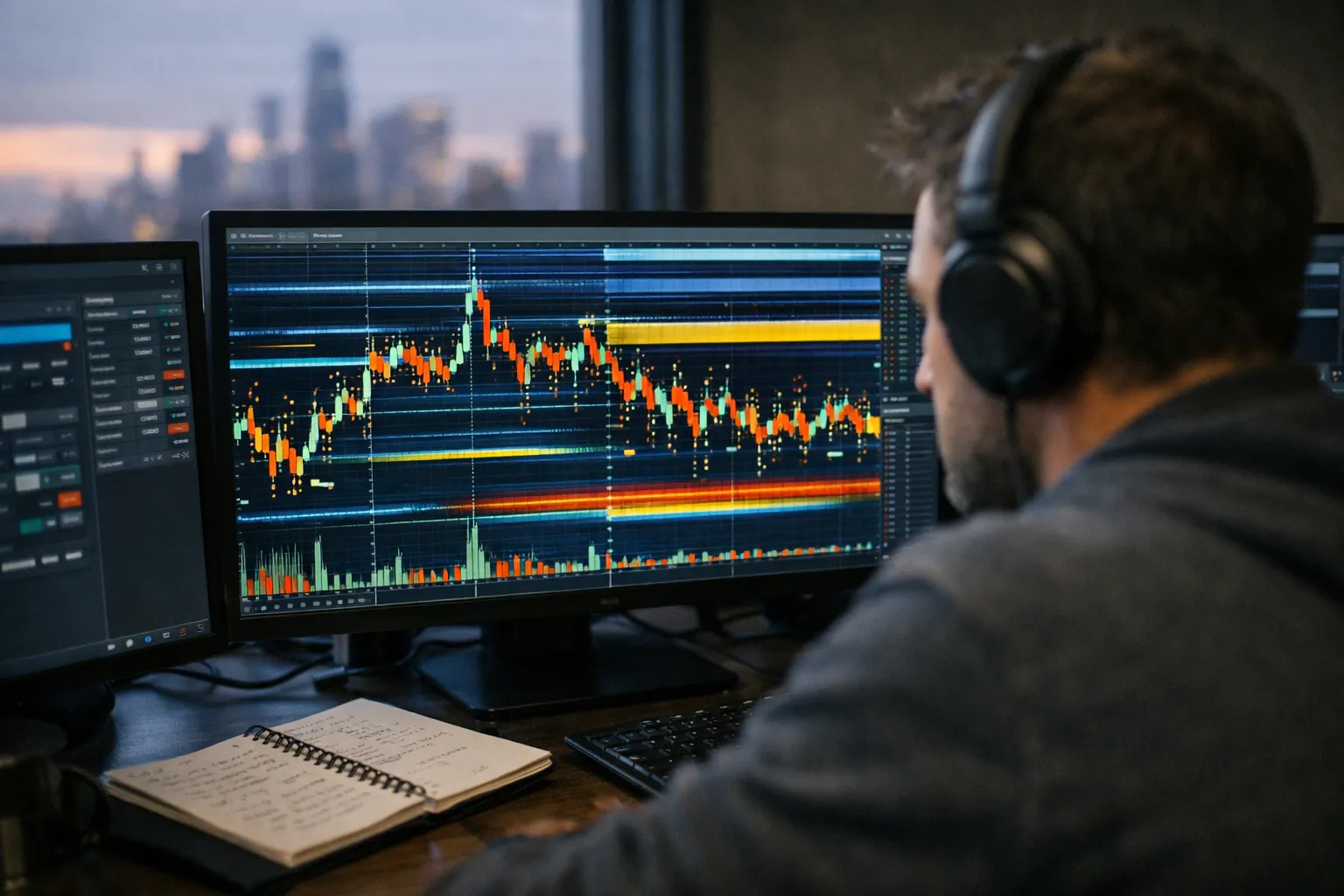
Bookmap has long been the market‑visualization choice for futures and equities traders who want a live, high‑resolution view of order‑book liquidity. In 2026 the platform remains a go‑to for crypto perpetual traders seeking order‑flow signals — but it also faces realistic limitations for anyone who expects an out‑of‑the‑box execution and algo workbench. This review evaluates Bookmap’s core capabilities, performance with major crypto venues, pros and cons, and who should (and shouldn’t) adopt it.
What Bookmap is and what it isn’t
At its core Bookmap is a real‑time visualizer: heatmaps that show resting liquidity, time‑weighted order‑book changes, and trade prints overlaid with volume markers. It excels at revealing iceberg orders, liquidity sweeps and transient walls that standard candles and depth bars obscure. What Bookmap does not replace is an execution system, a full back‑testing platform or a quantitative research stack — traders needing those must integrate Bookmap with separate tools.
Key features for crypto perpetual traders
- Order‑book heatmap — Live depth display that highlights where liquidity is clustered and how it evolves. For perpetuals this makes funding‑sensitive support/resistance and maker liquidity visible in a single pane.
- Volume Dots and Trade Prints — Colored markers that annotate trade size and aggressor side. Large takes near walls are easy to spot, which helps detect stop hunts or liquidity grabs before roll‑off.
- Replay & historical heatmaps — Replay lets traders step through recent sessions to study how liquidity behaved around big moves — valuable for refining execution triggers on BTC‑ and ETH‑perps.
- Exchange connectors — Bookmap supports direct market data and trading connectors for major derivatives venues (Binance, Bybit, Deribit, OKX and others). Connectors vary by subscription and sometimes lag new exchange API changes.
- Indicator & plugin ecosystem — Community and commercial plugins add features such as VWAP overlays, footprint heatmap customizations and simple strategy signals. Advanced algorithmic traders still rely on external execution layers.
Real‑world performance (Oct 2026)
I evaluated Bookmap connected to Binance USDT perpetuals and Deribit BTC options/perp via the native connectors on a sub‑10ms home fiber link and a low‑latency VPS located in Frankfurt. Results:
- Data fidelity: Heatmaps reflected order‑book changes with granular detail — iceberg creation and rapid cancels were consistently visible when the exchange websockets behaved normally.
- Latency: Display latency was largely a function of the exchange websocket and Internet routing. Bookmap’s rendering added minimal overhead, but users trading on sub‑5ms horizons (co‑located market‑making) cannot rely on a GUI alone.
- Stability: During a three‑day volatility event, Bookmap handled bursts but required higher CPU/GPU settings for smooth rendering. On lower‑spec machines the UI lagged during heavy churn.
Strengths
- Superior order‑flow visibility: The heatmap exposes meaningful microstructure signals that candle‑based charts miss — especially useful for identifying liquidity clusters ahead of leverage waterfalls in perpetuals.
- Flexible instrumentation: Custom indicators, multiple timeframes and replay make it a strong learning and analysis tool.
- Broad exchange coverage: Native connectors to major crypto derivatives venues simplify setups for traders who work across several order books.
- Community & support: Active forums, webinars and plugin developers accelerate onboarding for specific use cases like scalping or liquidity probing.
Weaknesses and limitations
- Not an execution workstation: Bookmap visualizes order flow but is not a full trading terminal. Native trading is supported only via exchange connectors and is far less sophisticated than dedicated algos or order‑management systems.
- Cost and data fees: Useful data (full depth, historical replay) is gated behind higher tiers and sometimes requires third‑party market‑data subscriptions. For many retail traders total cost can exceed what they expected.
- Hardware demands: High‑frequency visualization taxes CPU/GPU — smooth operation in churned periodes requires a modern workstation or VPS optimized for rendering.
- Headroom for bespoke algos: Traders who want programmatic execution tied to heatmap signals must build bridging software — Bookmap’s API and plugin model help, but this is non‑trivial.
Practical recommendations
If you trade crypto perpetuals and want to add order‑flow signals to your decision process, Bookmap should be in your toolkit. Practical tips from testing:
- Use Bookmap for signal confirmation — e.g., a perceived support level only becomes actionable when depth reappears and large passive orders hold there.
- Pair Bookmap with a low‑latency execution layer (a DMA provider, broker API or your own matching engine) rather than relying on Bookmap’s native order entry for high‑frequency strategies.
- Invest in a capable machine or VPS and limit open instruments to keep rendering smooth during volatility.
- Trial the replay functionality on a paid plan before committing: learning to read microstructure from heatmaps has a measurable learning curve.
Who should buy it — and who should not
Good fit:
- Active crypto perp scalpers and intraday traders who read liquidity and want early signals of large players.
- Market‑makers and prop desks that need visual monitoring of order‑book risk across multiple venues.
- Traders who will invest time integrating Bookmap with execution APIs for automated responses to order‑flow events.
Poor fit:
- Long‑term investors who rely on fundamentals and daily bars — Bookmap adds little to position sizing or portfolio construction.
- Retail traders unwilling to pay for data tiers or to learn the platform’s microstructure heuristics.
Alternatives
For visual order‑flow analysis consider Sierra Chart, Quantower or TradingView’s newer depth panels; Bookmap remains the most specialized for heatmap visualization, but these alternatives may offer stronger native order execution or lower costs depending on connectors and data needs.
Bottom line
Bookmap in 2026 remains the most compelling heatmap visualization tool for crypto perpetual traders seeking microstructure edge. Its strengths—granular order‑book visibility, replay and cross‑venue connectors—translate directly into better context for scalps and liquidity‑sensitive execution. However, it is a visualization and analysis tool, not a turnkey execution or algo platform. Serious traders should budget for advanced data tiers, a capable workstation and integration work to tie Bookmap signals into a reliable execution stack.