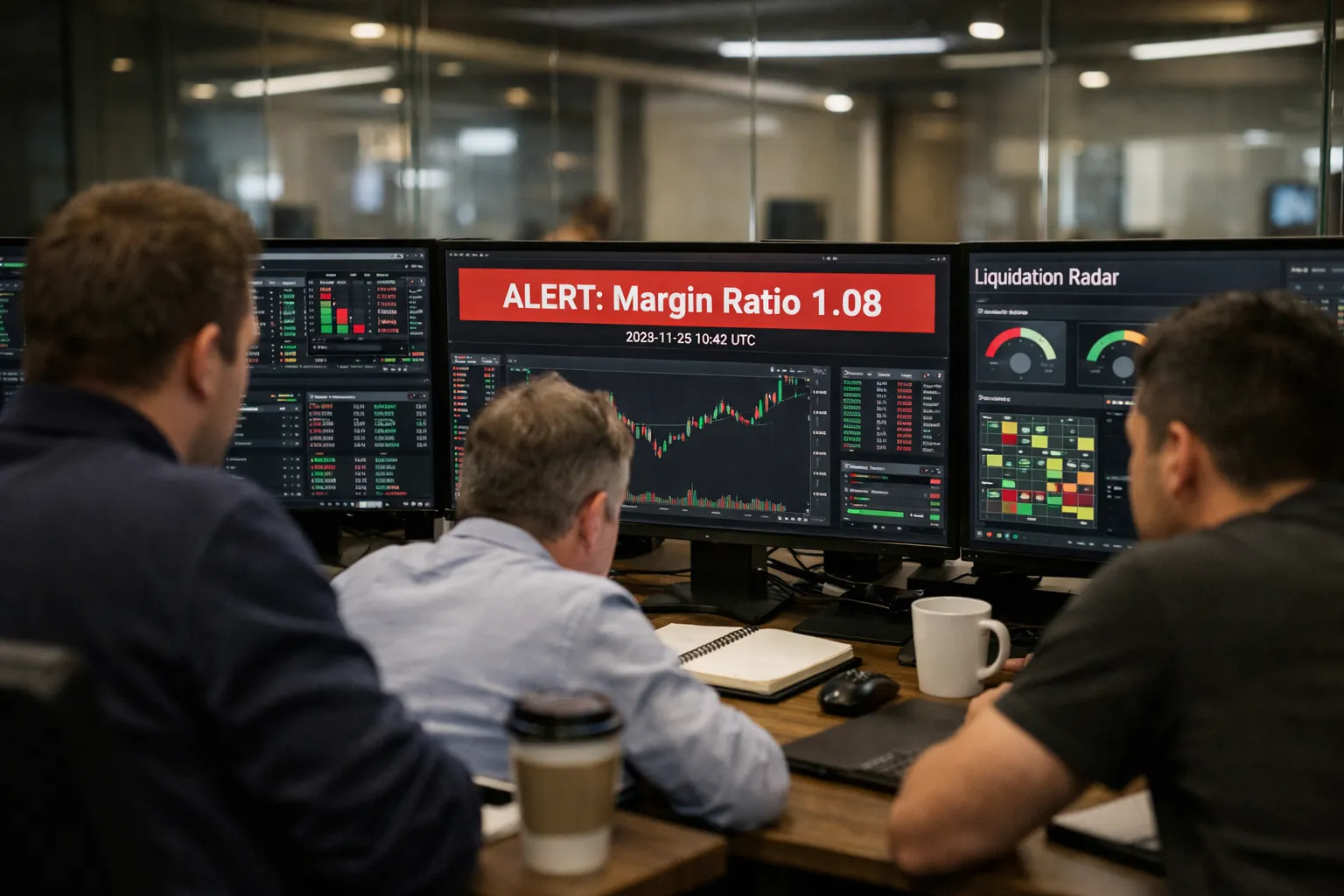
Margin traders in 2026 face a fragmented market: centralized exchanges, AMM perps on L2s, and centralized-like DEXs each expose positions to different margin and liquidation mechanics. A cross‑platform liquidation radar and auto‑risk manager gives active traders early warning and automated defense — reducing forced liquidations, preserving capital, and enabling faster, safer reactions during volatile events.
What this guide covers
This article walks you through designing, building, testing and operating a production‑grade liquidation radar and automated risk manager that:
- Monitors open positions and wallets across multiple CEXs (Binance, Bybit, OKX) and DeFi derivatives venues (GMX, Perpetual Protocol, dYdX, Drift);
- Calculates live liquidation risk using each venue’s maintenance margin rules and funding expectations;
- Issues graded alerts and executes preconfigured risk actions (reduce exposure, transfer collateral, hedge) with safety controls;
- Is resilient to API hiccups and designed for testable, auditable behavior.
Why a cross‑platform approach matters in Nov 2026
Liquidity and leverage are more distributed than ever: many traders run simultaneous positions across CEXs and L2 derivative DEXs to capture opportunities or manage counterparty concentration. A single‑venue risk monitor misses systemic signals — for example, collateral erosion on a DEX after a token price slip while a CEX position stays healthy. A unified view reduces catastrophe risk and supports nuanced automated responses.
High‑level architecture
Design the system with clear separation of concerns:
- Data collection layer — native REST and WebSocket clients per venue; token price feeds from spot aggregates and on‑chain oracles (Chainlink, Pyth);
- State engine — normalizes positions, balances, orders and margin rules into a canonical internal model;
- Risk calculator — applies venue‑specific liquidation formulas and simulates near‑term funding/fee flows;
- Decision engine — policy rules that map risk states to actions (alert, reduce, hedge, transfer collateral);
- Execution layer — order and transfer adapters with idempotency and multilayer safety (pre‑trade checks, cancels, dry‑run modes);
- Observability and control — logging, metrics, dashboards, audit trail and manual overrides.
Recommended tech stack
- Language: Go or Python with asyncio — Go for lower latency and concurrency, Python for faster iteration;
- Message bus: Redis Streams or Kafka for internal eventing;
- Short‑term state: Redis; durable storage: PostgreSQL with write‑ahead logs for audit;
- Metrics: Prometheus + Grafana; alerts: PagerDuty/Slack + SMS fallback;
- Secrets & key management: HashiCorp Vault or cloud KMS; hardware security module (HSM) recommended for large accounts;
- CI/CD: containerized deployments with staged environments (dev → staging → prod) and automated canary rollouts.
Data collection: APIs, websockets and oracles
Use native exchange APIs rather than generalized wrappers for critical data so you can handle idiosyncratic fields and rate limits. For each venue, subscribe to:
- Account position updates (WebSocket/account update streams where available);
- Orderbook snapshots and incremental updates for real‑time mark prices;
- Ticker and trade streams for cross‑venue price arbitration;
- Funding rate updates and time‑to‑funding for perpetuals;
- On‑chain events for DEXs: keep a light internal indexer or use third‑party node providers to detect position changes, margin calls, and price oracles.
Implement robust reconcilers: periodically (e.g., every 5–30s) snapshot positions via REST and compare to the stream state to avoid drift from missed websocket messages.
Normalization and canonical model
Each exchange exposes different fields. Normalize into a canonical Position object:
- venue_id, instrument (symbol + underlying), side, notional_value, entry_price, leverage, collateral_asset, collateral_amount, maintenance_margin_rate, liquidation_price, margin_mode (isolated/cross), last_updated
Include derived fields: current_mark_price, unrealized_pnl, margin_ratio = available_margin / maintenance_margin, projected_funding_impact (next N hours).
Liquidation math: implement exchange rules accurately
Liquidation formulas differ. For CEXs use their published formulas (Binance, Bybit, OKX docs). For DEXs the rules can be contract‑specific (e.g., GMX uses positionImpact and collateralized liquidity pools; Perpetual Protocol uses isolated margin math). For each venue, implement a unit test suite that validates your liquidation price and margin ratio calculations against sample cases from the venue docs.
Example: isolated long on CEX
- Position size: $50,000; entry price: $25,000 (2 BTC notional); collateral: USDT 5,000; leverage: 10x; maintenance_margin_rate: 0.5% (example).
- Maintenance margin = notional * maintenance_margin_rate = $50,000 * 0.005 = $250.
- Available margin = collateral + unrealized_pnl − initial_margin_used. Compute liquidation price solving for price where available_margin == maintenance_margin.
Always include funding projection: for a long funded at −0.02%/8h, a big negative funding can erode collateral on a short time horizon — factor expected funding over your decision window into projected margin ratio.
Decision engine: graded alerts and automated actions
Define multi‑tier policies rather than single binary triggers. Example graded states:
- Green: margin_ratio > 2.0 — no action;
- Amber: 1.3 ≤ margin_ratio ≤ 2.0 — notify trader, suggest preemptive reduction;
- Red: 1.0 margin_ratio 1.3 — auto‑reduce target exposure by X% or transfer collateral up to Y;
- Critical: margin_ratio ≤ 1.0 — emergency closure or hedge, and pause new orders for that venue/wallet.
Actions you can automate (with safety controls):
- Place a limit/market reduce order (partial close) on the same venue;
- Send a collateral token transfer from a hot wallet (if allowed and preapproved);
- Open an opposite hedge (e.g., short on another venue) to reduce net directional exposure;
- Cancel and replace risky OCO orders to reduce peak exposure during volatile windows.
Safety patterns
- Require a second factor (human or automated rule) for actions that transfer >X% of collateral or close >Y% of capital;
- Implement dry‑run / staging modes for new rules; log and review before escalation;
- Use idempotency keys and order verification to prevent duplicate disposals under retries;
- Implement an emergency "circuit breaker" that pauses all automated actions for 30s if the system detects cascading failures or anomalous exchange behavior.
Execution considerations
Latency vs safety tradeoffs: market closes execute fastest but cost more; limit reduces may fail in a crash. Use a tiered execution strategy:
- Try a passive limit reduce at the best achievable price;
- If not filled within a short adaptive timeout (e.g., 250–1000ms depending on venue latency), escalate to aggressive limit or market;
- For large positions, slice into TWAP/VWAP child orders to avoid slippage and signaling;
- For DEXs, consider gas batching and slippage protections via off‑chain quote checks and router contracts to avoid sandwiching and MEV exposure.
Backtesting and tabletop tests
Before real capital is at risk, run two layers of validation:
- Historical replay: ingest exchange history and websocket trade streams, replay position lifecycle and simulate decision engine behavior. Validate that liquidation triggers and mitigation actions behave as expected;
- Tabletop scenarios: design high‑severity, low‑frequency events — e.g., 40% token drop in 10 minutes on L2 AMM, exchange API outage, funding spike of −5%/8h — and run drills with ops and traders.
Operational runbook and alerts
Create clear runbooks that map alert levels to human actions and escalation paths. For example:
- Amber alert → Slack channel with position snapshot, recommended manual action, 10‑minute review window;
- Red alert → push SMS + PagerDuty, automated partial reduce initiated, 2‑minute human confirmation window for aggressive actions;
- Critical alert → auto close/hedge executed, incident created in tracker, post‑mortem mandatory.
Monitoring, audit and compliance
Maintain full audit trails: all decisions, inputs, and resulting orders must be timestamped and stored immutably. For regulated entities or institutional traders, ensure trade‑reconciliation reports and signed snapshots for compliance. Monitor for API anomalies (e.g., stale mark prices, sudden fee jumps) and instrument blacklists.
Example operational flow (simplified)
- WebSocket receives account update: position notional $120k, collateral $6k, maintenance_margin_rate 0.75%; computed margin_ratio = 1.12 → Red.
- Decision engine checks projected funding (next 8 hours = −0.15%) which would reduce collateral by ~$180 → margin_ratio projected to 1.05.
- Policy: for Red with projected deterioration, auto‑reduce by 30% via market reduce with idempotency key, and notify on PagerDuty.
- Execution layer places reduce order; order partially fills. System reconciles, updates position, and sends confirmation to trader; if fills are insufficient, escalate to transfer collateral path or hedge on alternate venue.
Key metrics to track
- False positive/negative rate for liquidation predictions;
- Average time‑to‑mitigation after Red alert;
- Amount of capital preserved via automated actions (historical comparison to baseline);
- Rate of failed executions and API errors by venue;
- Incident frequency and mean time to recover (MTTR).
Final checklist before going live
- Unit tests for each venue’s liquidation math and position normalization;
- End‑to‑end replay tests simulating a week of market data across venues;
- Staging deployment with real API keys but zero order volume (dry run of execution flow);
- Operational runbooks and at least two human approvers for high‑severity automated actions;
- Alert subscriptions and escalation policies validated end‑to‑end (PagerDuty, Slack, SMS).
Conclusion
A cross‑platform liquidation radar and auto‑risk manager transforms margin trading from a reactive to a proactive discipline. By combining accurate exchange‑specific math, graded policies, robust execution strategies and thorough testing, traders can reduce the odds of forced liquidations and maintain strategic agility across a fragmented derivatives landscape. Start small: instrument a subset of venues and iterate on decision policies as you gather real‑world telemetry — the system’s value compounds as coverage and data depth grow.